The Reality of Conductor Heating
A common issue in control panel design occurs when wire gauges are chosen strictly based on room-temperature current tables, without considering environmental heat or cable density.
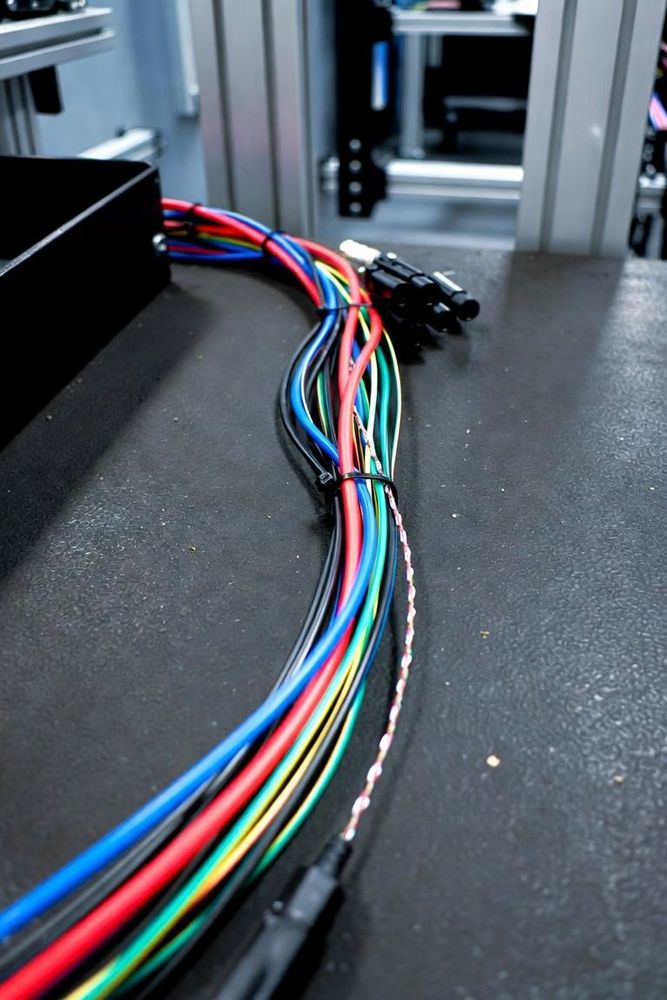
For instance, an engineering team might select a thin multi-conductor cable rated for 3 Amps per wire to control solenoids inside an industrial cabinet. On paper, the current draw aligns with the wire's baseline specification. However, during continuous summer operation, internal enclosure temperatures reach 55 degrees Celsius. To maintain clean cable routing, twenty of these multi-conductor cables are bundled tightly together inside a narrow plastic wiring duct.
Within two weeks, insulation melts and short-circuits the system. Opening the duct reveals that heat trapped at the center of the bundle softened the plastic insulation, causing it to migrate under pressure and create a direct copper-to-copper short.
This failure stems from a failure to account for thermal derating, cable bundling, and ambient operating temperatures.
The Mechanism of Thermal Accumulation
Every metal conductor exhibits electrical resistance. When current flows through a wire, a portion of that electrical energy converts directly into heat. This heat must transfer outward through the conductor insulation and dissipate into the surrounding environment.
The core temperature of the conductor continues to rise until the rate of heat generation matches the rate at which heat escapes into the surrounding air. A cable's temperature rating—such as 80, 105, or 200 degrees Celsius—defines the maximum continuous temperature its insulation can endure without softening, cracking, or losing its electrical insulating properties.
Standard PVC insulation is typically rated for 80 to 105 degrees Celsius. Cross-linked polyethylene, or XLPE, handles temperatures up to 125 degrees Celsius, while silicone and fluoropolymers like FEP or PTFE tolerate 150 to 200 degrees Celsius or higher. High-temperature insulations are essential in dense automotive engine compartments, aerospace applications, and hot industrial processing machinery.
Derating for Multi-Conductor Bundles
Standard wire ampacity charts assume a single conductor operating in open, unconfined air at an ambient temperature of 30 degrees Celsius.
When multiple current-carrying conductors are bundled tightly inside a cable sleeve, conduit, or wire duct, heat becomes trapped. The conductors near the center of the bundle are surrounded by other heat-generating wires rather than cool air, severely limiting their ability to shed thermal energy.
To prevent dangerous heat buildup, engineers must apply current derating factors that systematically reduce the allowable current per conductor based on bundle size:
- One to three current-carrying conductors: no reduction required, wires operate at 100 percent of baseline capacity.
- Four to six conductors: maximum allowable current drops to 80 percent of baseline.
- Seven to nine conductors: capacity drops to 70 percent.
- Ten to twenty conductors: allowable current is halved to 50 percent of its baseline open-air rating.
If a wire is rated for 5 Amps in open air, but is routed in a bundle of twelve fully loaded conductors, its safe continuous capacity drops to just 2.5 Amps per wire.
Factoring in Ambient Temperature and Voltage Drop
Beyond bundle density, ambient operating temperature requires additional adjustments. If the air surrounding a cable exceeds 30 degrees Celsius, a secondary thermal correction factor must be applied to further reduce allowable current capacity, ensuring the combined ambient and resistive heat does not exceed the insulation limit.
In addition to thermal safety, engineers must evaluate voltage drop along the cable length. Electrical resistance causes voltage to drop across long cable runs. If a 24-Volt power supply feeds a high-current load over a long distance through thin conductors, the voltage reaching the device can drop significantly below its minimum operating threshold, causing brownouts or unexpected system resets.
Always evaluate wire size using two distinct checks: first, verify thermal ampacity with all bundle and ambient temperature derating factors applied; second, calculate total voltage drop over the full cable length to ensure acceptable delivery voltage. Whichever calculation yields the larger required conductor size is the minimum gauge you must use for the application.