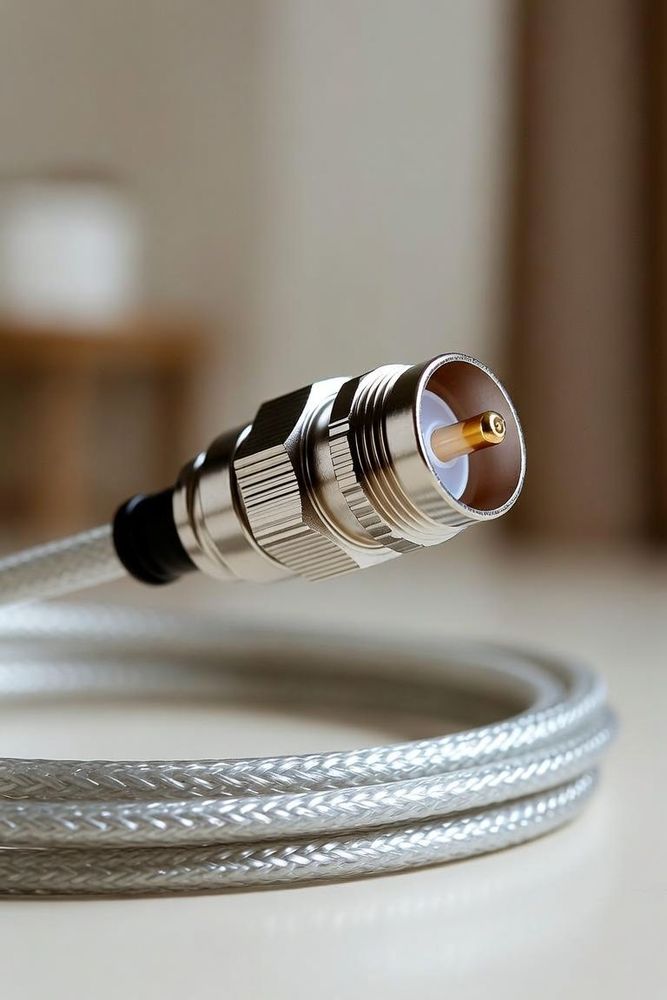
The Role of Coaxial Cable in Signal Transmission
Coaxial cable carries RF and high-frequency signals through a concentric construction: a central conductor, a dielectric insulator, an outer shield, and a protective jacket. This geometry confines the electromagnetic field almost entirely within the cable, giving coax excellent shielding against external interference compared to unshielded twisted-pair alternatives.
Standard Impedance Classes
Coaxial cable is manufactured to standardized characteristic impedance values, and mixing impedance classes on a single link introduces reflections and signal loss:
- 50-ohm coax: the standard for RF, wireless, and data communications applications, matching the impedance of most RF connectors (SMA, BNC, N-type, FAKRA in most automotive configurations).
- 75-ohm coax: the standard for video and broadcast applications, including analog and digital video distribution.
Construction Types
Flexible Coax
Standard flexible coaxial cable uses a braided or foil shield and a flexible dielectric, suitable for general-purpose RF interconnects and cable assemblies requiring routine flexing during installation.
Low-Loss Coax
Low-loss variants use lower-loss dielectric materials and optimized conductor geometry to minimize signal attenuation over longer cable runs — important for high-frequency cellular, GNSS, or WiFi antenna feed applications where every dB of loss reduces link margin.
Semi-Rigid and Conformable Coax
Semi-rigid coax uses a solid outer conductor that holds its shape once formed, offering excellent shielding and stability for fixed RF interconnects inside equipment. Conformable coax offers similar electrical performance with a shield that can be hand-formed without special tooling, useful for prototyping and field installation.
Micro-Coaxial Cable
Micro-coax uses extremely small-diameter construction for space-constrained applications such as internal RF routing in compact consumer electronics, cameras, and dense connector interfaces.
Shielding Effectiveness
Coax shield construction directly affects how much external interference the cable rejects and how much of its own signal it radiates. Single-braid shields offer good general-purpose performance; double-braid or braid-plus-foil constructions offer meaningfully better shielding effectiveness for sensitive or high-frequency applications, at added cost and reduced flexibility.
Matching Coax to Connector Interfaces
Coaxial cable must be matched not just electrically (impedance) but mechanically to its connector interface — center conductor diameter, dielectric outer diameter, and overall cable outer diameter all need to align with the connector manufacturer's specified cable compatibility list. Using an unlisted cable with a given connector, even at the correct nominal impedance, can produce a poor mechanical crimp or solder joint and degraded high-frequency performance.