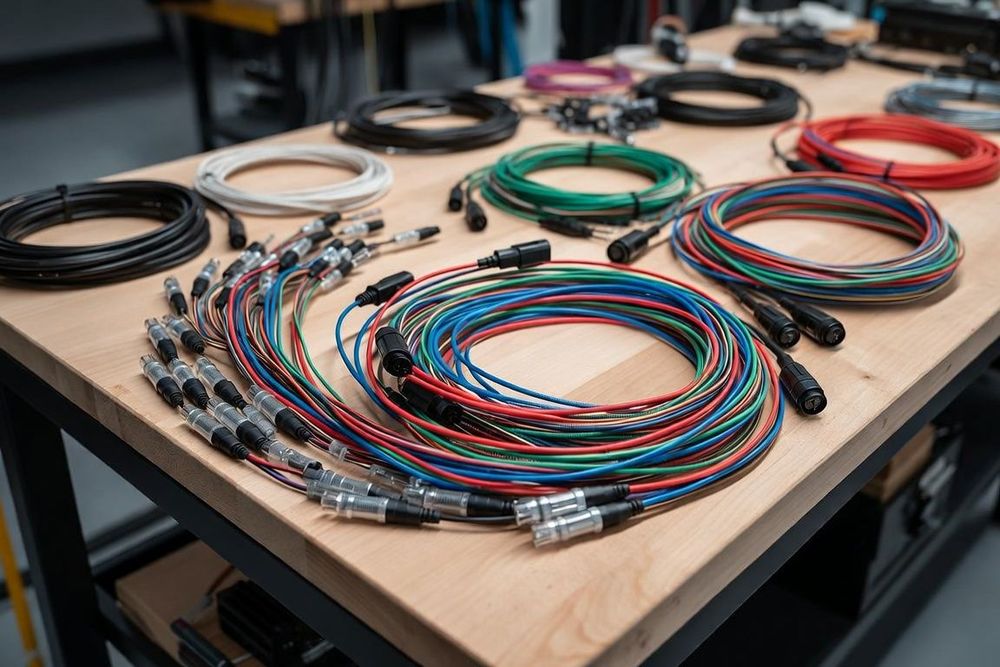
Defining Raw Cable
Raw cable — also called bulk cable — refers to cable sold in its unterminated form, without connectors or crimped terminals attached to either end. It is purchased by length (often by the meter, foot, or on reels of hundreds of meters) and terminated later, either by the purchasing company's own manufacturing line or by a contract cable assembly house building to a customer's specification.
Raw Cable vs. Cable Assembly
The distinction matters for sourcing and design decisions. A cable assembly is a finished product — cable pre-terminated with connectors on one or both ends, ready to install. Raw cable is the intermediate material: the conductor, insulation, and jacket construction, without any termination. Engineering teams that need a standard, high-volume interconnect typically buy finished assemblies. Teams building custom equipment, or needing non-standard lengths, connector combinations, or termination methods, typically buy raw cable and terminate it in-house or through a contract manufacturer.
Common Raw Cable Categories
- Coaxial cable: single-conductor shielded cable for RF and high-frequency signal transmission.
- Audio/video cable: multi-conductor cable designed for analog or digital media signal transmission.
- Data communications cable: twisted-pair or multi-conductor cable for structured data networking, including Cat5e/Cat6/Cat6A constructions.
- Power cable: single or multi-conductor cable rated for current-carrying capacity rather than signal integrity.
- Specialty and high-temperature cable: cable engineered for specific environmental demands, such as high-temperature shielded control cable rated well beyond standard PVC-jacketed wire limits.
How Raw Cable Is Specified
Purchasing raw cable requires specifying several parameters beyond just cable type: conductor material and gauge (AWG), number of conductors, insulation material and voltage rating, jacket material and outer diameter, shielding construction (foil, braid, or both), and any relevant regulatory or industry certifications (UL listing, RoHS compliance, or industry-specific standards like ICEA or AEIC for power cable).
Why Buy Raw Cable Instead of a Finished Assembly
Sourcing raw cable directly makes sense when a project needs non-standard lengths cut to exact specification, custom termination combinations not available as a stock assembly, or when the purchasing team has in-house crimping and termination capability and can achieve better unit economics by buying bulk material and terminating internally. It also gives engineering teams more control over exact cable construction — jacket material, shield type, and conductor stranding — than is typically available when buying a pre-configured finished assembly.